
By Harold Pease, Ph. D.
November 21, 2025, was predicted 60 years ago. Rep. María Elvira Salazar (R-FL) introduced H. Con. Res. 58, titled “Denouncing the Horrors of Socialism.” The resolution “condemned socialism in all its forms, citing historical examples of socialist policies leading to authoritarianism, famine, mass murder, and economic collapse in places like the Soviet Union under Lenin/Stalin, China under Mao, Cuba under Castro, and Venezuela under Maduro” where collectively well over 100 million people lost their lives. It explicitly stated that Congress “denounces socialism in all its forms, and opposes the implementation of socialist policies in the United States,” while affirming that socialist policies are incompatible with America’s founding principles.” Historically socialism was by far the most violent form of government in world history (“Death by Socialism,” By Harold Pease, Ph. D., LibertyUnderFire. org, Aug. 20, 2019).
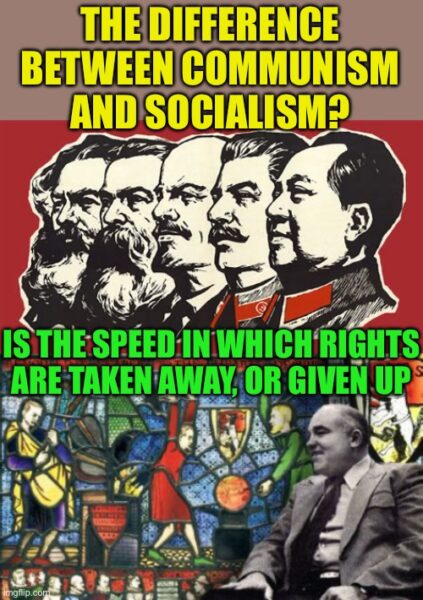
The measure denouncing socialism passed but 98 Democrats voted no (against the resolution) 2 Democrats voted present, 27 Democrats did not vote. In other words, 127 Dems Congressmen did not condemn socialism nor did 20 Republicans, one third of all members of the House. These need to be removed in the nearest election as unfit for public office in a free society.
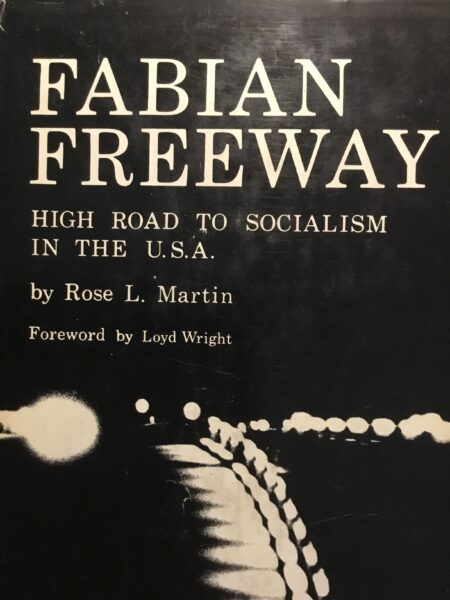
One book stands out more than any other predicting what has happened to the two nations most responsible for the birth of liberty world wide—England and America—that they in turn would be conquered by a secret combination designed to undermine the great work of our Founding Fathers, the Constitution and the Republic they created. The Book, Fabian Freeway: High Road to Socialism in the U.S.A. 1884–1966, (Western Islands) by Rose L. Martin presents an anti-socialist critique tracing the influence of the largely secret British Fabian Society on the spread of socialist ideas and policies in both Great Britain and the United States. The work correctly frames Fabianism as an insidious, gradualist strategy for achieving socialism without violent revolution— likened to the slow, patient advance of a turtle (or “Fabian turtle”) rather than the abrupt upheaval of Marxist communism.
The book’s central thesis is that a small group of elite, “polite revolutionaries”—intellectuals who operated under the guise of moderate reform, social welfare, and human progress—deliberately, methodically undermined traditional institutions, particularly the British Empire, and extended their influence across the Atlantic to reshape American society. Martin argues this “high road” to socialism proved more effective than overt communism because it infiltrated education, media, government, and political parties stealthily, avoiding direct confrontation while advancing collectivist goals.
Part I: Great Britain – The Origins and Impact. The first section focuses on the Fabian Society’s founding in London in 1884 by key figures such as Sidney and Beatrice Webb, George Bernard Shaw, Graham Wallas, and others. Martin describes their motto—”Make Haste Slowly” (festina lente)—as emblematic of a calculated, evolutionary approach to socialism. Unlike revolutionary Marxists, Fabians advocated “permeation”: infiltrating existing institutions (especially the Liberal Party initially, then the emerging Labour Party) to enact incremental reforms that would eventually lead to state control over the economy and society. Chapters detail how Fabians “sowed the wind” through intellectual networks, influential writings (e.g., the Webbs’ works on municipal socialism and poor law reform), and strategic alliances. Martin portrays them as “dangerous” due to their elitism, deceptive moderation, and success in placing members in high positions—editors, academics, politicians, and civil servants. She highlights their role in shaping the British Labour Party, which she sees as a Fabian vehicle.
The narrative covers the interwar period, where Fabians allegedly engaged in “sedition” by supporting policies that weakened imperial strength, including diplomatic recognition of Bolshevik Russia (engineered by Fabian Arthur Henderson as Foreign Secretary in 1929). Martin laments the postwar “dirge for an empire,” arguing that Fabian influence contributed to decolonization, economic decline, and the welfare state’s expansion under Labour governments (e.g., post-1945 Attlee administration). She views World War II and its aftermath as a “trial by ordeal” that accelerated socialist trends, with Fabians positioning themselves for global influence (“Tomorrow, the World?”).
Part II: The United States – The Fabian “Turtle” Crosses the Atlantic. The second half shifts to America, contending that Fabian ideas migrated via intellectual exchanges, British émigrés, American progressives influenced by Fabian thought, and organizations mirroring Fabian tactics. Martin claims early permeation occurred through academics, journalists, and reformers who adopted gradualist socialism as liberalism or progressivism.
Key arguments include:Fabians “put the silk hat on socialism” by making it respectable among elites. Influential professors and intellectuals carried ideas to U.S. universities and policy circles.The New Deal era under Franklin D. Roosevelt marked a major advance, with “the professor” (possibly alluding to figures like Rexford Tugwell or others seen as Fabian-influenced) going to Washington to implement centralized planning. “Perfect friendship” and “left hands across the sea” refer to transatlantic networks linking British Fabians with American counterparts in government, media (e.g., ties to publications like The New Republic), and diplomacy. Postwar developments showed continuity: “the more it changes, the more it remains the same,” with Fabian-style policies
advancing through regional planning, urban redevelopment, agricultural collectivization trends, and welfare expansion.
Martin warned that by the 1960s, these influences had created a “freeway” (faster-paced modern equivalent of the old turtle trail) for socialism in America, carried out by executive agents, diplomats, and planners who reorganized society along collectivist lines while maintaining capitalist appearances. After millions of deaths from the philosophy one would think the intellectuals would have long since forsaken the philosophy and NOT embraced it on both continents, but they did!!!
Dr. Harold Pease is an expert on the United States Constitution and a syndicated columnist on current events. Read his weekly columns at www.LibertyUnderFire.org Column #864
Help preserve our Republic while we still can by sharing this column.