
By Harold Pease, Ph. D.
The power of the song Silent Night was demonstrated in one of the most destructive wars in world history just 98 years after written in 1816 and within miles of where written. Father Joseph Mohr, wrote the words as a poem while he was serving in Mariapfarr, Germany, two years later he had Franz Xaver create a melody for it. Mohr and Gruber performed the song for the first time at Midnight Mass, The carol was famously associated with sparking the unofficial Christmas Truce on December 25, 1914, in World War I along the Western Front. No song had ever paused a war, this one did.
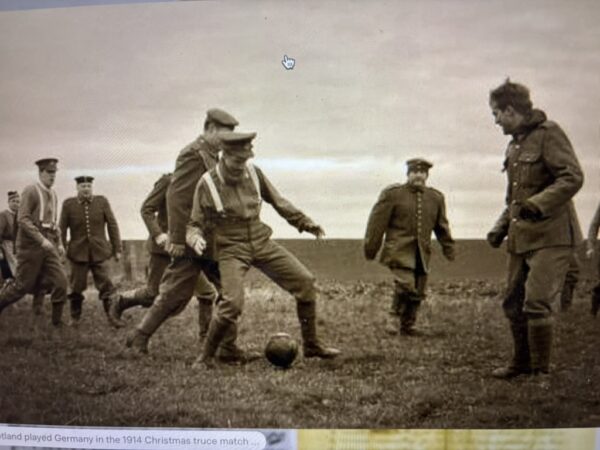
During the early months of WWI, in frozen trenches near Ypres, Belgium, German soldiers began decorating their parapets with small Christmas trees and lanterns on Christmas Eve. They started singing carols, and in one sector, a German tenor (oftebbn identified as opera singer Lieutenant Walter Kirchhoff) sang “Stille Nacht.” British troops across no-man’s-land recognized the melody, joined in with the English version “Silent Night,” and responded with their own carols like “God Rest Ye Merry Gentlemen.” This shared singing created a spontaneous ceasefire in several areas: soldiers emerged from trenches, exchanged
Did German and British troops, each heavily involved in trench warfare attempting to kill the other, really stop fighting and play football on Christmas Day, December 25, 1914? Reportedly the eve before, a British soldier named Edgar Aplin sang a solo with his beautiful tenor voice which carried to the trench of his opponent. The German soldiers listened in the darkness and called out for another song. Aplin obliged and the Germans responded with Silent Night. Then, somehow, in the midst of the fighting, on Christmas 1914, a temporary peace took place. Singing Christmas carols led to both sides leaving their trenches, than to conversation, then to a game of football. The miracle of the music fostered comradely for a single day. gifts (cigarettes, food, buttons), buried their dead, conversed, and even played impromptu football matches.
The truce was not universal—fighting continued in some sectors—and high commands on both sides disapproved, ensuring no large-scale repetition in later years. Yet this moment of humanity amid horror has become legendary, symbolizing shared culture transcending enmity. There had never been a day like this or since when a simple tune about the birth of Jesus Christ paused the guns and the death on both sides for a day. But there was never a tune more universally loved by the human family having been translated into more than 300 languages.
Dr. Harold Pease is a syndicated columnist and an expert on the United States Constitution. He has dedicated his career to studying the writings of the Founding Fathers and applying that knowledge to current events. He taught history and political science from this perspective for over 30 years at Taft College. Newspapers have permission to publish this column. Read his weekly columns at, www.LibertyUnderFire.org Column # 852.
Subscribe now for free columns at this address. Help preserve our Republic while we still can.